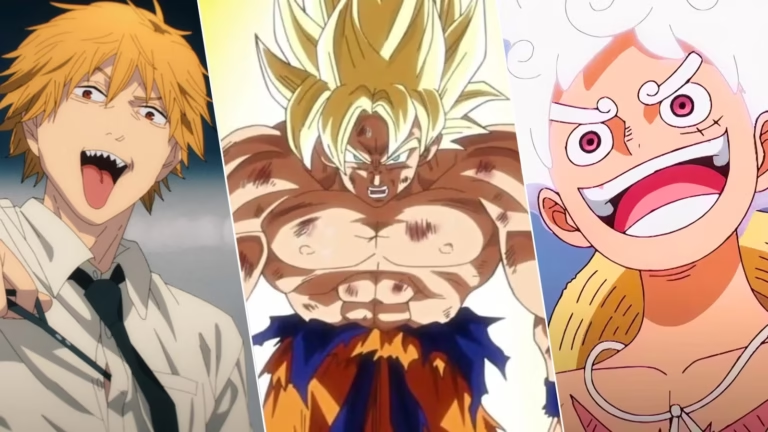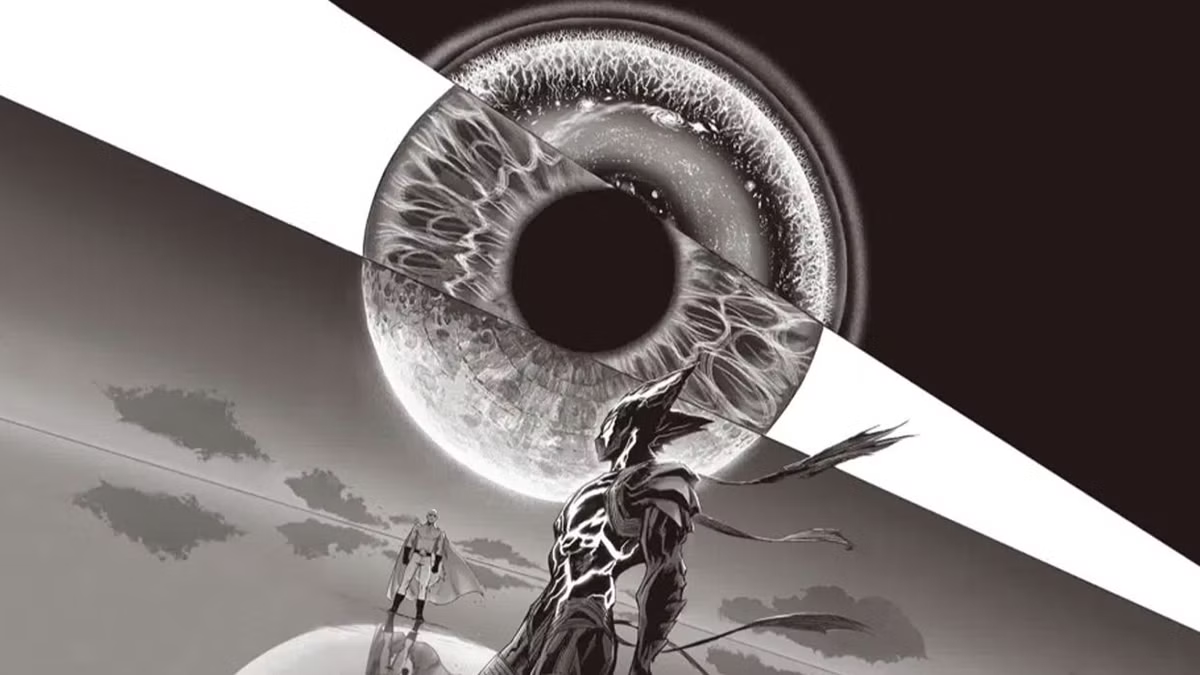

Tactical action manga stands out because the outcome of a fight can depend on planning, teamwork, information, and timing rather than raw strength alone. A character may be physically weaker and still win by reading the opponent, setting a trap, or using a teammate at exactly the right moment.
That difference changes the whole feeling of a battle.
A good tactical story can make you pause over a single panel and think, “Wait, was that move planned three chapters ago?” That kind of payoff is one reason strategy-heavy action series are so satisfying. The fights still have speed and danger, yet the reader has something else to track: decisions.
What Makes Tactical Action Manga Different?
The biggest difference is that action has consequences. A character cannot always charge forward, use the strongest attack, and solve the problem. The story may give them three fighters, limited information, ten minutes, and one route through a building. Suddenly every choice matters.
Imagine a team of four trying to capture one target inside a train station. The strongest fighter can handle direct combat, but another character controls movement, a third gathers information, and the fourth protects civilians. If the strongest member runs ahead alone, the team can actually become weaker.
That is the kind of setup that makes tactical battles feel believable.
How strategy changes a fight
Strategy can appear in several simple forms:
- Choosing the right opponent instead of the strongest one.
- Creating a distraction before attacking.
- Saving an ability for the final phase of a battle.
- Forcing the enemy into a narrow area.
- Giving false information to make the opponent react early.
A classic example would be a character pretending to be exhausted. The opponent moves closer, expecting an easy finish, only to discover that the tired performance was bait.
The trick works because the enemy made a decision based on incomplete information.
Why team roles matter
Team-based stories become stronger when every character has a clear function. A five-person squad might include a scout, close-range fighter, defensive specialist, support character, and strategist.
That setup creates useful tension.
Suppose the scout discovers two enemy groups approaching from different streets. The strategist now has to decide which route to defend. The wrong choice could leave the support member exposed. Even if nobody throws a single punch, the scene already has pressure.
Good tactical writing also gives weaker characters something meaningful to contribute. A character with little physical power might create the opening that allows another fighter to win.
Also Read: Best Action Manga to Read: Top Series & Story Picks.
How Does Tactical Action Manga Use Strategy?
Strategy in manga usually works through information. Characters rarely know everything at once, and that gap creates opportunities for smart decisions.
For example, imagine an enemy with a powerful ability that works only within a 20-foot range. The heroes do not know that at first. Once they discover the limit, the fight changes from “How do we survive?” to “How do we keep this opponent outside the danger zone?”
That one number can reshape the entire battle.
Reading the opponent
Strong tactical battles often include observation before action.
A character may notice that an enemy always protects the left side of their body. Another may realize that a certain attack requires two seconds of preparation. Small clues become valuable because they reduce uncertainty.
A reader should pay attention to repeated details. If a character checks the clock three times before attacking, that probably means the timing matters.
A useful battle can make an earlier scene feel more meaningful later.
Managing limited resources
Strategy gets more interesting when characters cannot use every option whenever they want.
Maybe a fighter has three special attacks, but the strongest one drains their stamina for several minutes. Maybe a support character can heal one person once. Maybe the team has only two smoke devices for an entire mission.
Now every use becomes a decision.
Consider a group hiding inside an abandoned warehouse. They have one smoke grenade and two escape routes. Using the grenade early might help them escape the first enemy wave, but saving it could be the only way to survive the final confrontation.
Good stories make the reader understand why the choice matters before showing the result.
Using terrain and timing
A location can become part of the strategy.
A narrow hallway limits movement. A rooftop creates visibility but removes cover. A flooded room may interfere with equipment. Even something simple like a staircase can change the balance between two fighters.
Timing matters just as much.
A character who attacks at 9:58 instead of 9:55 may force the enemy into a completely different position. In a story involving a rescue mission with a ten-minute deadline, waiting 30 seconds can be more dangerous than fighting immediately.
This is where tactics feel connected to the story rather than added as decoration.
Also Read: Best Drama Manga to Read: Emotional Stories and Top Picks.
Why Do Teams Make Action Stories More Interesting?
A team creates several moving parts at once. The reader is no longer watching one character solve one problem. There may be four separate goals happening during the same battle.
That can produce excellent moments of coordination.
Specialist roles
Teams work well when their members cover different weaknesses.
For example:
| Role | Main job | Example use |
|---|---|---|
| Scout | Gather information | Finds the enemy’s hidden position |
| Defender | Protect teammates | Holds a doorway for 30 seconds |
| Attacker | Apply pressure | Forces the enemy away from cover |
| Support | Improve team options | Creates an escape route |
| Strategist | Coordinate decisions | Chooses when the team advances |
This structure also helps character development. A quiet support member may become essential after the main fighter loses access to their usual technique.
That moment feels earned because the team already established the role.
Trust and communication
Some battles are decided by communication alone.
Picture two characters fighting an opponent they cannot see clearly. One character hears footsteps but cannot identify the direction. The other notices a reflection in a window and immediately understands what is happening.
A single sentence can then trigger a coordinated move.
Stories like this work because the characters have built enough trust to act quickly without explaining every detail.
Team conflicts
Perfect teamwork can become boring.
A more interesting group has disagreements. One person wants to attack. Another wants to wait. A third thinks the mission objective should come before personal revenge.
Those conflicts give tactical decisions emotional weight.
Imagine a rescue team that has five minutes left. One member wants to save an injured enemy because they may know where the missing hostage is. Another wants to leave immediately. The decision now affects the plot, the team’s trust, and future relationships.
That is much richer than a simple victory screen.
Also Read: Best Adventure Manga to Read: Epic Journeys and New Worlds.
What Are Mind Games in Manga Battles?
Mind games happen when characters try to control what the opponent believes.
The key idea is simple: the enemy does not need to be defeated physically right away. Their decision can be manipulated first.
Bluffing and misinformation
A bluff works when a character makes the opponent believe something that is not true.
For example, a fighter might deliberately reveal a weak attack three times. The opponent begins to assume that the move has no hidden purpose. On the fourth attempt, the fighter changes the timing and catches them during a counterattack.
The action is simple. The thinking behind it is what makes the scene memorable.
Predicting the opponent
Mind games can also involve predicting habits.
Maybe an enemy always attacks the closest target. Maybe they never turn their back on a particular rival. Maybe they choose the safest-looking route.
After several observations, a character can build a prediction.
That prediction is still a gamble.
If the hero expects the opponent to repeat their behavior at 8:00 and the enemy changes tactics at 7:59, the entire plan can collapse.
Good stories allow plans to fail.
Turning a disadvantage into an advantage
One of the strongest tactical moments comes when a weakness becomes useful.
A slower fighter may intentionally create a battle in a narrow room. A character with weak long-range attacks might force the opponent into close quarters. Someone with limited energy could pretend to have even less, encouraging the enemy to become careless.
For instance, a team might appear trapped on the second floor of a building. The enemy assumes the group has nowhere to go, but the heroes already noticed a service elevator during an earlier scene.
The escape works because the story planted information in advance.
What Story Elements Should You Look For?
A tactical battle becomes much easier to appreciate when you watch for more than the action itself.
Consequences and decisions
Ask what each major choice changes.
If a character uses a special move, what do they lose? If the team splits up, what becomes harder? If they trust the wrong person, what happens next?
A useful example is a two-stage mission. The heroes successfully defeat a guard in Chapter 20, but the fight consumes five minutes they needed for the second objective. Winning the first exchange creates a new problem.
That feels much closer to a real mission.
Character motives
Strategy becomes stronger when decisions match personality.
A cautious character may protect information. A proud fighter may take a risky challenge. A loyal teammate might refuse to abandon someone even when the tactical choice says to retreat.
Those motives can produce unexpected outcomes.
Imagine the strategist orders a retreat with 40 seconds left, but the team leader stays behind because they promised to bring everyone home. The order is logical, yet the emotional choice creates the next conflict.
Battles that affect the wider story
The best tactical fights rarely exist in isolation.
A battle may reveal an enemy’s ability, expose a secret alliance, change political relationships within the story, or force a character to rethink their role.
For example, a team wins a mission but accidentally reveals its communication method. The next enemy encounter becomes harder because the opposition has learned from that battle.
That kind of continuity rewards readers who pay attention.
How Can You Tell If a Series Has Real Strategy?
A series does not need complicated charts or endless explanations to feel tactical. Five signs usually give you a good idea.
- Plans have clear goals.
The reader knows what the characters are trying to accomplish. For example, “hold the bridge for three minutes” is easier to understand than a vague objective. - Information matters.
Learning an enemy’s weakness should change how characters behave. A 20-foot attack range, for instance, should affect positioning. - Characters have limits.
Unlimited abilities remove much of the tension. A fighter who can use a special technique only twice has meaningful choices to make. - Plans can fail.
A tactical story should allow surprises. The enemy may detect the trap or respond in a way the heroes did not expect. - Earlier details pay off later.
If a character notices a broken window in Chapter 4 and escapes through it in Chapter 9, the payoff feels earned.
The common mistake is assuming that complicated dialogue equals smart strategy. It does not. A battle can have ten minutes of explanation and still make little sense.
Clear cause and effect matter more.
Also Read: Best Comedy Manga to Read: Funny Series and Top Picks.
Where Do Readers Usually Read Manga?
Readers often use a manga reader interface because it makes long chapters easier to follow, especially on a phone or tablet. Features such as page direction, bookmarks, chapter history, and image quality can make a noticeable difference during a 40-page chapter.
You may also encounter search terms and platform names such as Manga dex, Mangaforfree, Mangaforest, and Mangadna while looking for series.
Availability can change, and some websites may not have permission to distribute every title they list. Before you Read manga from an unfamiliar source, check the publisher, creator, or official platform for licensed availability in your country.
A simple example: a series available officially in the United States may have a different release schedule or catalog from one offered in another region.
What should a good manga reader offer?
For a smoother reading experience, look for basic features such as:
- Clear page images with readable text.
- Reliable chapter organization.
- Progress tracking or bookmarks.
- Mobile-friendly page controls.
- A clear indication of where the material comes from.
Those details matter more than flashy extras.
What Tactical Battle Scenarios Work Best in Manga?
Some story setups naturally create better tactical pressure than a simple one-on-one duel.
1. Rescue missions
A rescue mission gives characters multiple priorities. Save the hostage, avoid unnecessary fights, and escape before the building is surrounded.
For example, a team may have 15 minutes before reinforcements arrive. Fighting every guard becomes a bad option, so stealth and timing suddenly matter.
2. Defensive battles
Defending one location creates a clear objective.
A group might need to protect a bridge, gate, vehicle, or injured teammate. Even if the heroes are stronger, they can still lose by failing to protect the target.
A 30-second delay can be more valuable than a knockout.
3. Outnumbered teams
Being outnumbered creates natural tactical problems.
Four heroes facing ten opponents cannot simply trade attacks one after another. They may divide the field, create chokepoints, or force the enemy to interfere with itself.
A hallway wide enough for only two fighters can turn a 4-vs-10 battle into several smaller encounters.
4. Timed objectives
Time limits add pressure without requiring an overwhelmingly powerful villain.
Imagine a character needs to disable three machines before a countdown reaches zero. Fighting the guards is only one part of the problem. Choosing the order of the machines may matter even more.
Now every second has value.
Why Do Readers Remember Strategic Battles?
Readers tend to remember battles where the final result makes sense in hindsight.
Think about the difference between a surprise power-up and a carefully planted plan. A surprise can be exciting for a moment. A plan that connects details from ten chapters earlier can stay in your head much longer.
One strong example is delayed information. Suppose a character spends several chapters appearing careless, then later reveals that they memorized the enemy’s patrol pattern. Earlier behavior suddenly gets a different meaning.
That kind of payoff makes rereading worthwhile.
There is also a satisfaction in understanding the plan slightly before the reveal. You notice the clues, make a prediction, and then see the characters confirm it.
That’s a very different experience from simply waiting to see who has the bigger attack.
How Should Beginners Start Reading Strategy-Heavy Manga?
Start with the battle objective instead of trying to understand every ability immediately.
When a new fight begins, ask four quick questions:
- What does each side want?
- What can each side do?
- What information is still unknown?
- What happens if they fail?
Take a fictional example: Team A needs to protect a van for eight minutes. Team B needs to stop the van from leaving. Suddenly every move has a purpose. A character blocking a road, destroying a tire, or creating a distraction can be judged by how it affects those eight minutes.
This simple approach makes complicated fights easier to follow.
And it helps you spot weak strategy too. If a character makes a huge move but you cannot explain what problem it solves, the scene may be relying more on spectacle than planning.
What Makes a Tactical Series Worth Rereading?
The best reason to reread a strategy-heavy manga is hidden information.
On the first read, you see the mystery. On the second, you know the answer and can watch the setup.
A three-panel conversation can suddenly matter. A strange character reaction can become obvious. Even the order of a team formation may reveal who expected trouble.
For example, imagine a character asks, “How many exits are there?” during an ordinary conversation. Ten chapters later, the team escapes through the third exit. That tiny question becomes part of the larger plan.
Those details reward patient readers.
6. FAQ Section
What is tactical action manga?
Tactical action manga focuses on fights and missions where strategy, information, teamwork, and timing affect the result. A character might win by exploiting a 10-second opening rather than having greater physical strength.
Are team battles better than one-on-one fights?
Team battles offer more variables because several characters can have different abilities and objectives. For example, a scout finding an enemy position can be just as important as the main fighter winning a duel.
What are mind games in manga?
Mind games involve manipulating what an opponent thinks, expects, or believes. A character might bluff about an ability, fake weakness, or predict a repeated habit before making a move.
How can I tell if a battle has real strategy?
Look for clear objectives, character limits, meaningful information, and cause-and-effect decisions. If a character learns that an attack works only within 20 feet and changes their position because of it, the strategy has a concrete effect.
What should I look for in a manga reader?
Basic features such as clear pages, chapter organization, bookmarks, and easy mobile controls are useful. For licensed reading, also check whether the source has official distribution rights for the series in your region.
Where can I Read manga legally?
Legal availability depends on the title, publisher, and country. A good starting point is the manga publisher or an established licensed reading service that clearly lists the series.
7. Conclusion
The most useful way to judge a tactical action series is simple: watch the decisions, not just the punches. Strong tactics connect goals, information, limitations, and consequences so that the final result feels earned rather than random.
Look for one thing above all: a battle where knowing more and thinking better can genuinely change what happens next.
Tactical action manga stands out because the outcome of a fight can depend on planning, teamwork, information, and timing rather than raw strength alone. A character may be physically weaker and still win by reading the opponent, setting a trap, or using a teammate at exactly the right moment.
That difference changes the whole feeling of a battle.
A good tactical story can make you pause over a single panel and think, “Wait, was that move planned three chapters ago?” That kind of payoff is one reason strategy-heavy action series are so satisfying. The fights still have speed and danger, yet the reader has something else to track: decisions.
What Makes Tactical Action Manga Different?
The biggest difference is that action has consequences. A character cannot always charge forward, use the strongest attack, and solve the problem. The story may give them three fighters, limited information, ten minutes, and one route through a building. Suddenly every choice matters.
Imagine a team of four trying to capture one target inside a train station. The strongest fighter can handle direct combat, but another character controls movement, a third gathers information, and the fourth protects civilians. If the strongest member runs ahead alone, the team can actually become weaker.
That is the kind of setup that makes tactical battles feel believable.
How strategy changes a fight
Strategy can appear in several simple forms:
- Choosing the right opponent instead of the strongest one.
- Creating a distraction before attacking.
- Saving an ability for the final phase of a battle.
- Forcing the enemy into a narrow area.
- Giving false information to make the opponent react early.
A classic example would be a character pretending to be exhausted. The opponent moves closer, expecting an easy finish, only to discover that the tired performance was bait.
The trick works because the enemy made a decision based on incomplete information.
Why team roles matter
Team-based stories become stronger when every character has a clear function. A five-person squad might include a scout, close-range fighter, defensive specialist, support character, and strategist.
That setup creates useful tension.
Suppose the scout discovers two enemy groups approaching from different streets. The strategist now has to decide which route to defend. The wrong choice could leave the support member exposed. Even if nobody throws a single punch, the scene already has pressure.
Good tactical writing also gives weaker characters something meaningful to contribute. A character with little physical power might create the opening that allows another fighter to win.
How Does Tactical Action Manga Use Strategy?
Strategy in manga usually works through information. Characters rarely know everything at once, and that gap creates opportunities for smart decisions.
For example, imagine an enemy with a powerful ability that works only within a 20-foot range. The heroes do not know that at first. Once they discover the limit, the fight changes from “How do we survive?” to “How do we keep this opponent outside the danger zone?”
That one number can reshape the entire battle.
Reading the opponent
Strong tactical battles often include observation before action.
A character may notice that an enemy always protects the left side of their body. Another may realize that a certain attack requires two seconds of preparation. Small clues become valuable because they reduce uncertainty.
A reader should pay attention to repeated details. If a character checks the clock three times before attacking, that probably means the timing matters.
A useful battle can make an earlier scene feel more meaningful later.
Managing limited resources
Strategy gets more interesting when characters cannot use every option whenever they want.
Maybe a fighter has three special attacks, but the strongest one drains their stamina for several minutes. Maybe a support character can heal one person once. Maybe the team has only two smoke devices for an entire mission.
Now every use becomes a decision.
Consider a group hiding inside an abandoned warehouse. They have one smoke grenade and two escape routes. Using the grenade early might help them escape the first enemy wave, but saving it could be the only way to survive the final confrontation.
Good stories make the reader understand why the choice matters before showing the result.
Using terrain and timing
A location can become part of the strategy.
A narrow hallway limits movement. A rooftop creates visibility but removes cover. A flooded room may interfere with equipment. Even something simple like a staircase can change the balance between two fighters.
Timing matters just as much.
A character who attacks at 9:58 instead of 9:55 may force the enemy into a completely different position. In a story involving a rescue mission with a ten-minute deadline, waiting 30 seconds can be more dangerous than fighting immediately.
This is where tactics feel connected to the story rather than added as decoration.
Why Do Teams Make Action Stories More Interesting?
A team creates several moving parts at once. The reader is no longer watching one character solve one problem. There may be four separate goals happening during the same battle.
That can produce excellent moments of coordination.
Specialist roles
Teams work well when their members cover different weaknesses.
For example:
| Role | Main job | Example use |
|---|---|---|
| Scout | Gather information | Finds the enemy’s hidden position |
| Defender | Protect teammates | Holds a doorway for 30 seconds |
| Attacker | Apply pressure | Forces the enemy away from cover |
| Support | Improve team options | Creates an escape route |
| Strategist | Coordinate decisions | Chooses when the team advances |
This structure also helps character development. A quiet support member may become essential after the main fighter loses access to their usual technique.
That moment feels earned because the team already established the role.
Trust and communication
Some battles are decided by communication alone.
Picture two characters fighting an opponent they cannot see clearly. One character hears footsteps but cannot identify the direction. The other notices a reflection in a window and immediately understands what is happening.
A single sentence can then trigger a coordinated move.
Stories like this work because the characters have built enough trust to act quickly without explaining every detail.
Team conflicts
Perfect teamwork can become boring.
A more interesting group has disagreements. One person wants to attack. Another wants to wait. A third thinks the mission objective should come before personal revenge.
Those conflicts give tactical decisions emotional weight.
Imagine a rescue team that has five minutes left. One member wants to save an injured enemy because they may know where the missing hostage is. Another wants to leave immediately. The decision now affects the plot, the team’s trust, and future relationships.
That is much richer than a simple victory screen.
What Are Mind Games in Manga Battles?
Mind games happen when characters try to control what the opponent believes.
The key idea is simple: the enemy does not need to be defeated physically right away. Their decision can be manipulated first.
Bluffing and misinformation
A bluff works when a character makes the opponent believe something that is not true.
For example, a fighter might deliberately reveal a weak attack three times. The opponent begins to assume that the move has no hidden purpose. On the fourth attempt, the fighter changes the timing and catches them during a counterattack.
The action is simple. The thinking behind it is what makes the scene memorable.
Predicting the opponent
Mind games can also involve predicting habits.
Maybe an enemy always attacks the closest target. Maybe they never turn their back on a particular rival. Maybe they choose the safest-looking route.
After several observations, a character can build a prediction.
That prediction is still a gamble.
If the hero expects the opponent to repeat their behavior at 8:00 and the enemy changes tactics at 7:59, the entire plan can collapse.
Good stories allow plans to fail.
Turning a disadvantage into an advantage
One of the strongest tactical moments comes when a weakness becomes useful.
A slower fighter may intentionally create a battle in a narrow room. A character with weak long-range attacks might force the opponent into close quarters. Someone with limited energy could pretend to have even less, encouraging the enemy to become careless.
For instance, a team might appear trapped on the second floor of a building. The enemy assumes the group has nowhere to go, but the heroes already noticed a service elevator during an earlier scene.
The escape works because the story planted information in advance.
What Story Elements Should You Look For?
A tactical battle becomes much easier to appreciate when you watch for more than the action itself.
Consequences and decisions
Ask what each major choice changes.
If a character uses a special move, what do they lose? If the team splits up, what becomes harder? If they trust the wrong person, what happens next?
A useful example is a two-stage mission. The heroes successfully defeat a guard in Chapter 20, but the fight consumes five minutes they needed for the second objective. Winning the first exchange creates a new problem.
That feels much closer to a real mission.
Character motives
Strategy becomes stronger when decisions match personality.
A cautious character may protect information. A proud fighter may take a risky challenge. A loyal teammate might refuse to abandon someone even when the tactical choice says to retreat.
Those motives can produce unexpected outcomes.
Imagine the strategist orders a retreat with 40 seconds left, but the team leader stays behind because they promised to bring everyone home. The order is logical, yet the emotional choice creates the next conflict.
Battles that affect the wider story
The best tactical fights rarely exist in isolation.
A battle may reveal an enemy’s ability, expose a secret alliance, change political relationships within the story, or force a character to rethink their role.
For example, a team wins a mission but accidentally reveals its communication method. The next enemy encounter becomes harder because the opposition has learned from that battle.
That kind of continuity rewards readers who pay attention.
How Can You Tell If a Series Has Real Strategy?
A series does not need complicated charts or endless explanations to feel tactical. Five signs usually give you a good idea.
- Plans have clear goals.
The reader knows what the characters are trying to accomplish. For example, “hold the bridge for three minutes” is easier to understand than a vague objective. - Information matters.
Learning an enemy’s weakness should change how characters behave. A 20-foot attack range, for instance, should affect positioning. - Characters have limits.
Unlimited abilities remove much of the tension. A fighter who can use a special technique only twice has meaningful choices to make. - Plans can fail.
A tactical story should allow surprises. The enemy may detect the trap or respond in a way the heroes did not expect. - Earlier details pay off later.
If a character notices a broken window in Chapter 4 and escapes through it in Chapter 9, the payoff feels earned.
The common mistake is assuming that complicated dialogue equals smart strategy. It does not. A battle can have ten minutes of explanation and still make little sense.
Clear cause and effect matter more.
Where Do Readers Usually Read Manga?
Readers often use a manga reader interface because it makes long chapters easier to follow, especially on a phone or tablet. Features such as page direction, bookmarks, chapter history, and image quality can make a noticeable difference during a 40-page chapter.
You may also encounter search terms and platform names such as Manga dex, Mangaforfree, Mangaforest, and Mangadna while looking for series.
Availability can change, and some websites may not have permission to distribute every title they list. Before you Read manga from an unfamiliar source, check the publisher, creator, or official platform for licensed availability in your country.
A simple example: a series available officially in the United States may have a different release schedule or catalog from one offered in another region.
What should a good manga reader offer?
For a smoother reading experience, look for basic features such as:
- Clear page images with readable text.
- Reliable chapter organization.
- Progress tracking or bookmarks.
- Mobile-friendly page controls.
- A clear indication of where the material comes from.
Those details matter more than flashy extras.
What Tactical Battle Scenarios Work Best in Manga?
Some story setups naturally create better tactical pressure than a simple one-on-one duel.
1. Rescue missions
A rescue mission gives characters multiple priorities. Save the hostage, avoid unnecessary fights, and escape before the building is surrounded.
For example, a team may have 15 minutes before reinforcements arrive. Fighting every guard becomes a bad option, so stealth and timing suddenly matter.
2. Defensive battles
Defending one location creates a clear objective.
A group might need to protect a bridge, gate, vehicle, or injured teammate. Even if the heroes are stronger, they can still lose by failing to protect the target.
A 30-second delay can be more valuable than a knockout.
3. Outnumbered teams
Being outnumbered creates natural tactical problems.
Four heroes facing ten opponents cannot simply trade attacks one after another. They may divide the field, create chokepoints, or force the enemy to interfere with itself.
A hallway wide enough for only two fighters can turn a 4-vs-10 battle into several smaller encounters.
4. Timed objectives
Time limits add pressure without requiring an overwhelmingly powerful villain.
Imagine a character needs to disable three machines before a countdown reaches zero. Fighting the guards is only one part of the problem. Choosing the order of the machines may matter even more.
Now every second has value.
Why Do Readers Remember Strategic Battles?
Readers tend to remember battles where the final result makes sense in hindsight.
Think about the difference between a surprise power-up and a carefully planted plan. A surprise can be exciting for a moment. A plan that connects details from ten chapters earlier can stay in your head much longer.
One strong example is delayed information. Suppose a character spends several chapters appearing careless, then later reveals that they memorized the enemy’s patrol pattern. Earlier behavior suddenly gets a different meaning.
That kind of payoff makes rereading worthwhile.
There is also a satisfaction in understanding the plan slightly before the reveal. You notice the clues, make a prediction, and then see the characters confirm it.
That’s a very different experience from simply waiting to see who has the bigger attack.
How Should Beginners Start Reading Strategy-Heavy Manga?
Start with the battle objective instead of trying to understand every ability immediately.
When a new fight begins, ask four quick questions:
- What does each side want?
- What can each side do?
- What information is still unknown?
- What happens if they fail?
Take a fictional example: Team A needs to protect a van for eight minutes. Team B needs to stop the van from leaving. Suddenly every move has a purpose. A character blocking a road, destroying a tire, or creating a distraction can be judged by how it affects those eight minutes.
This simple approach makes complicated fights easier to follow.
And it helps you spot weak strategy too. If a character makes a huge move but you cannot explain what problem it solves, the scene may be relying more on spectacle than planning.
What Makes a Tactical Series Worth Rereading?
The best reason to reread a strategy-heavy manga is hidden information.
On the first read, you see the mystery. On the second, you know the answer and can watch the setup.
A three-panel conversation can suddenly matter. A strange character reaction can become obvious. Even the order of a team formation may reveal who expected trouble.
For example, imagine a character asks, “How many exits are there?” during an ordinary conversation. Ten chapters later, the team escapes through the third exit. That tiny question becomes part of the larger plan.
Those details reward patient readers.
FAQ Section
What is tactical action manga?
Tactical action manga focuses on fights and missions where strategy, information, teamwork, and timing affect the result. A character might win by exploiting a 10-second opening rather than having greater physical strength.
Are team battles better than one-on-one fights?
Team battles offer more variables because several characters can have different abilities and objectives. For example, a scout finding an enemy position can be just as important as the main fighter winning a duel.
What are mind games in manga?
Mind games involve manipulating what an opponent thinks, expects, or believes. A character might bluff about an ability, fake weakness, or predict a repeated habit before making a move.
How can I tell if a battle has real strategy?
Look for clear objectives, character limits, meaningful information, and cause-and-effect decisions. If a character learns that an attack works only within 20 feet and changes their position because of it, the strategy has a concrete effect.
What should I look for in a manga reader?
Basic features such as clear pages, chapter organization, bookmarks, and easy mobile controls are useful. For licensed reading, also check whether the source has official distribution rights for the series in your region.
Where can I Read manga legally?
Legal availability depends on the title, publisher, and country. A good starting point is the manga publisher or an established licensed reading service that clearly lists the series.
Conclusion
The most useful way to judge a tactical action series is simple: watch the decisions, not just the punches. Strong tactics connect goals, information, limitations, and consequences so that the final result feels earned rather than random.
Look for one thing above all: a battle where knowing more and thinking better can genuinely change what happens next.
For more useful articles, visit my website: Www-mangadex.org.